Development: 4 months
Team: 2 students, 3rd Semester Game Design Bachelor at HTW Berlin
Software: Unity, Rider, Maya, zBrush, Substance Painter, Photoshop
Plattform: PC
Constrains: Remote development/ corona pandemic
Development: 4 months
Team: 2 students, 3rd Semester Game Design Bachelor at HTW Berlin
Software: Unity, Rider, Maya, zBrush, Substance Painter, Photoshop
Plattform: PC
Constrains: Remote development/ corona pandemic
Our team’s primary objective for this project was to deliver captivating gameplay, coupled with a uniquely immersive game world. As a result, the game’s mechanics are intricately intertwined with the environment, creating a seamless player experience. To add a thematic twist, we chose ‘Halloween’ as the theme for Beyond Bounds’ first level.


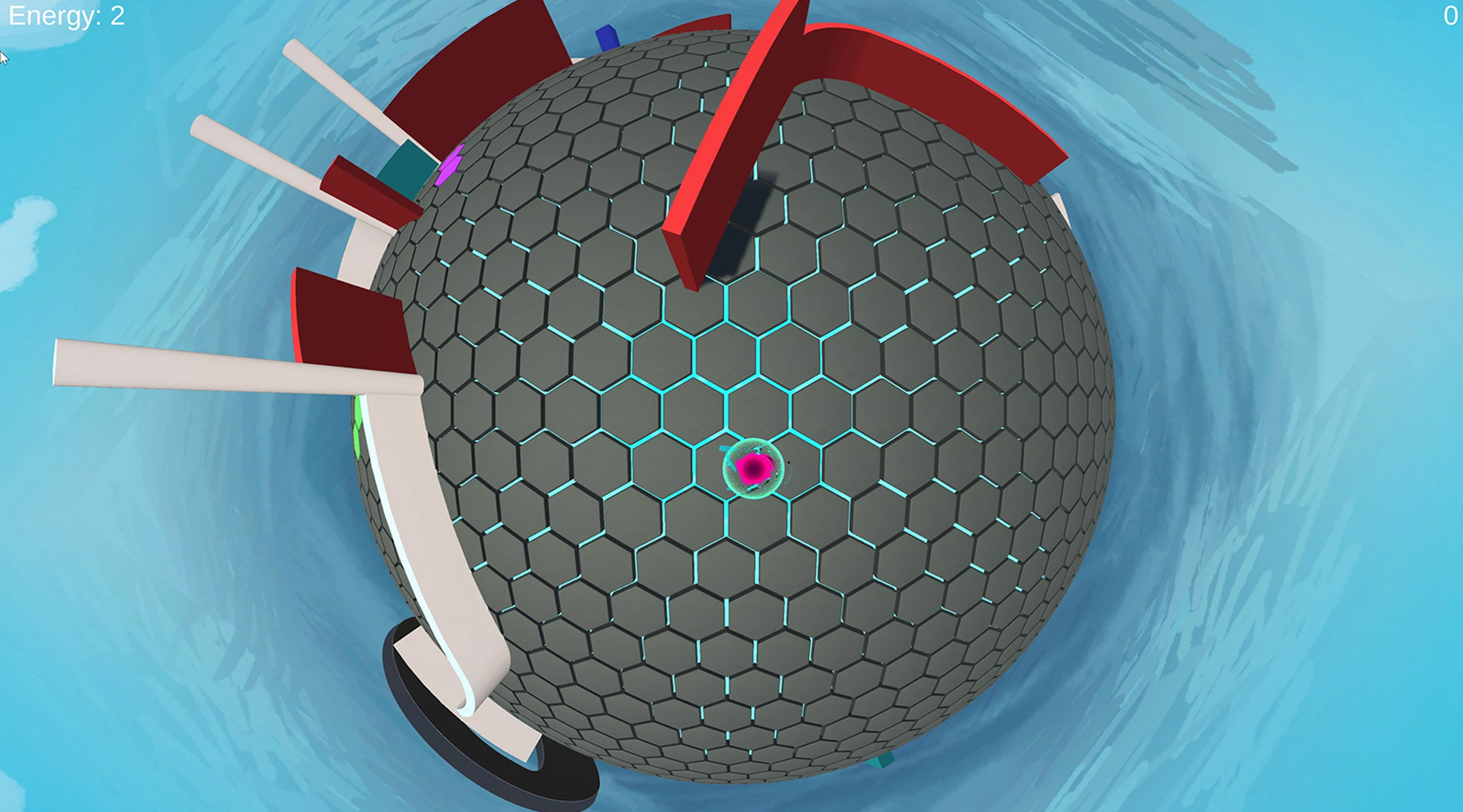

The core twist of this project is that there’s no sphere at all—it is all trickery and unfolds in “2D.”
Before the vertices reach Clipspace, they’re cleverly bent: the further away they are, the stronger the effect. This trick lets us pull distant Hextiles (far behind us) forward to make it tile, compressing an enormous game world into the surface of a tiny planet—here scaled down by about 10x!
We called it a Planetscroller since it reminds us of sidescrolling but in all directions. Under the hood, the game takes advantage of data-oriented design with Unity DOTS. It effortlessly outpaces even the highly suited TimSort algorithm, that works well on partially sorted tuples.


To support this mechanic, I developed a set of custom Editor Tools tailored for efficient level creation. Since the level layout is not always as it appears—edges in this tiling geometry can sit unusually close together—a dedicated tool was built to reshuffle them into new, coherent arrangements.
Additional tools include a Hextile Generator, a Parenting Solver, Culling Adjuster, a Bounding Box Modifier and also things like CameraShaker all designed to streamline the workflow and optimize performance (e.g. setpassCalls & drawcalls).
The project also features a semi-procedural curve system: Bezier curves with smoothing are used to generate natural, flowing bridges. The Verts, Normals and Uvs are directly typed into the system.
Catmull–Rom splines handle pathfinding, ensuring smooth navigation for the player on the bridges, with a tau of about 0.65. (1 means the autocurve is very sensitiv to small changes)
To preserve performance with many game objects, I used baked lighting. I built a tool that collects emissive materials, excludes non-static objects, and boosts emissive intensity for the bake. I also loaded a secondary scene with emissive spheres to improve light baking, which are removed after the process.
I built a complex unlit toon shader designed to keep things lightweight while still supporting a high level of visual detail. Instead of relying on complex real-time shading, we bake detail from multiple maps—including normals—directly into the diffuse texture using overlay and multiply blending. This makes the final result efficient while still visually rich, as seen on the tower to the right.


This is a selection of the visual effects I created for the game. I worked primarily with Unity’s Shuriken Particle System, the VFX Graph, and also used blendshapes in Maya to achieve specific animations and transitions.
The project involved a wide variety of VFX — from simple ambient effects to more complex, dynamic systems. Some effects, like the moon and the arcane energy surrounding the planet, presented unique challenges. To make them work as intended, I bound them to the player, ensured they rendered last in the queue, and scaled them dynamically based on field of view and player speed for a more immersive and responsive result.

The 3D models were kept simple and low-poly to maintain performance, which also matched the game’s stylized art direction. Sculpting was used to create slightly quirky, expressive forms that added character while staying lightweight. The Bush is some trickery because it is hard to look underneath it.


We had the opportunity to present the game at Hive Five at HTW. Due to COVID-19 restrictions, the event was streamed live, allowing viewers to watch us talk about the development process and play the game in real time.
During Development we had a bi-weekly presentation and also a weekly meeting with the coach.
